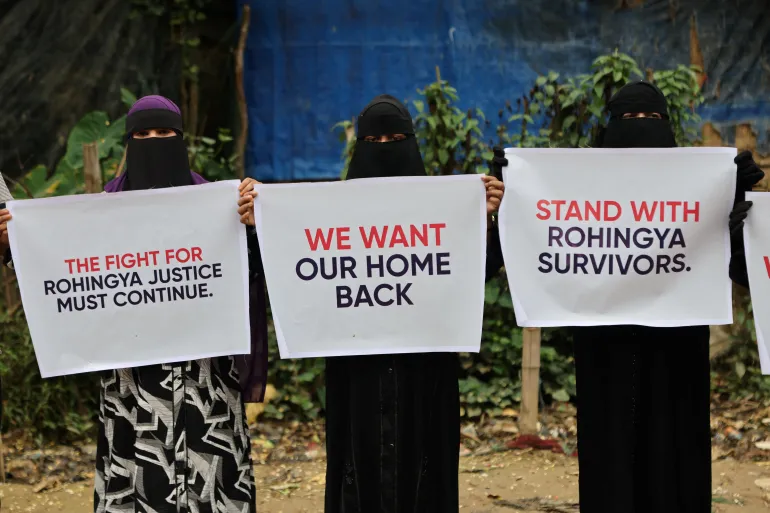
The International Court of Justice has ruled that Myanmar committed genocide against its Rohingya Muslim minority in northern Rakhine State, marking the first time in the history of the United Nations top judicial body that a sovereign nation has been held directly responsible for perpetrating genocide.
Delivering the landmark judgment at the Peace Palace in The Hague on Thursday, November 19, Court President Yuji Iwasawa announced that a 9 to 6 majority of the 15 judge panel concluded that Myanmar's military security forces committed 3 distinct acts prohibited under the 1948 Genocide Convention during the brutal 2017 crackdown. Specifically, the court confirmed that state forces carried out mass killings of Rohingya members, inflicted serious bodily and mental harm, and imposed deliberate measures intended to prevent births within the community. Judges determined that, evaluating the overwhelming pattern of atrocities together, the only reasonable inference explaining Myanmar's actions was a specific state intent to destroy a substantial part of the Rohingya population. The court also ruled by 11 votes to 4 that Myanmar violated its obligation to preserve evidence by burning and destroying remnants of at least 5 Rohingya villages in May 2020 and constructing a government base on the site of a former village in 2021.
Brought forward in November 2019 by The Gambia on behalf of the Organization of Islamic Cooperation and formally supported through legal interventions by 11 countries including the Maldives, Canada, the United Kingdom, Germany, and France, the case represents a watershed moment in international accountability. In previous landmark rulings such as the Bosnian genocide case, the World Court had only found states culpable for failing to prevent genocide rather than directly committing the crime. By a vote of 13 to 2, the panel ordered Myanmar to immediately investigate and prosecute everyone reasonably suspected of committing genocidal acts during the 2017 operations, while a 10 to 5 majority mandated that authorities facilitate the safe, voluntary, and dignified return of displaced Rohingya refugees, restore lost property, and pay financial compensation to survivors.
The ruling was met with emotional relief among Rohingya survivors watching live broadcasts inside crowded refugee camps in Cox's Bazar, Bangladesh, where over a million displaced community members continue to shelter. While Myanmar's military regime dismissed the verdict as unfair and a great disappointment, international human rights advocates and intervening states welcomed the legally binding decision and urged the United Nations Security Council to enforce compliance ahead of the 2 year deadline given to Myanmar to report back on restitution and compensation measures.
Comments 0
No comments yet. Be the first to share your thoughts!